
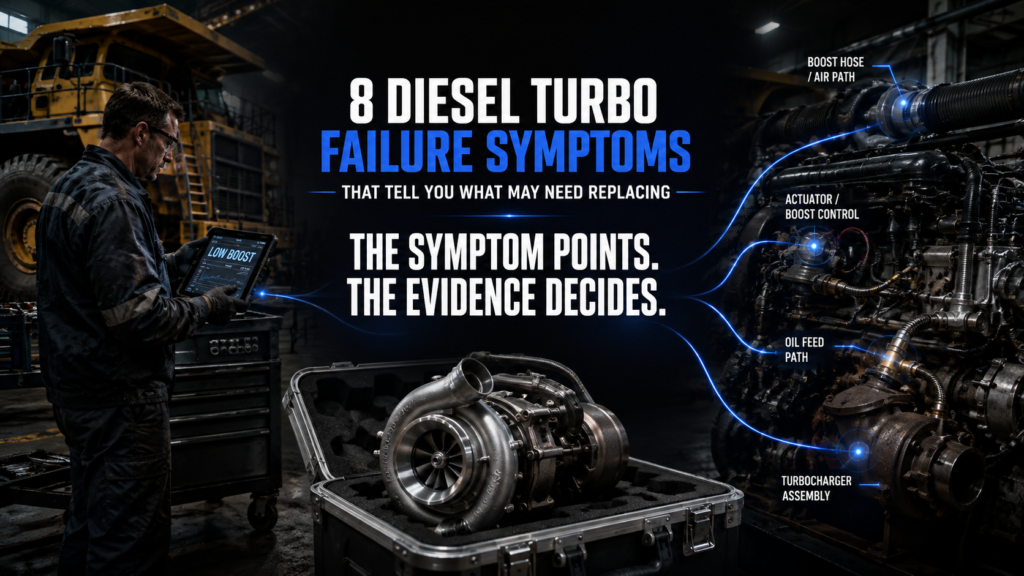
Power drops under load. The turbo sounds different. Smoke appears where it never used to. Then the engine drops into limp mode or stores a boost fault.
Those are genuine diesel turbo failure symptoms, but they do not automatically mean the complete turbocharger has failed. A split boost hose, faulty actuator, restricted oil feed, blocked exhaust path or sensor fault can create very similar behaviour.
The useful question is not simply, “Is the turbo bad?”
It is:
“What has failed, and what actually needs replacing?”
For a workshop, maintenance manager or heavy-equipment buyer, that distinction can prevent the wrong component being ordered and keep an already costly downtime event from becoming longer.
Key Takeaways
- Loss of power, smoke, unusual noise, oil use and boost faults can point to turbo trouble, but other components can create the same symptoms.
- Check the air path, boost-control system and oil circuit before condemning the complete turbocharger.
- Physical wheel damage, wheel-to-housing contact, seized rotation and confirmed bearing damage make turbo replacement far more likely.
- Once the fault is confirmed, match the replacement using the engine application, OEM number and turbo part number.
What Do Diesel Turbo Failure Symptoms Actually Tell You?
Turbo symptoms narrow the fault path. They do not name the replacement part.
BorgWarner’s turbocharger troubleshooting guidance links low power, black smoke, blue smoke, excessive oil use and abnormal noise to several possible causes, including air restrictions, leaking pressure lines, oil-feed or drain problems, crankcase ventilation faults, fuelling problems and internal turbo damage.
For workshops and maintenance teams, a sensible fault path works from the surrounding systems towards the turbo itself:
- Air path: air filter, intake ducting, boost hoses, clamps, charge-air cooler and manifold connections.
- Boost control: actuator, wastegate or VGT/VNT mechanism, vacuum supply, wiring and boost-control solenoids.
- Oil and exhaust support: oil feed, oil return, crankcase ventilation, exhaust leaks and exhaust restriction.
- Turbo core: shaft, bearings, compressor wheel, turbine wheel, housing and rotor movement.
The symptom tells you where to investigate. Testing tells you what should be replaced.
8 Diesel Turbo Failure Symptoms and What May Need Replacing
1. Noticeable Loss of Power Under Load
Power loss is often one of the first changes operators notice because the engine no longer pulls as strongly as it did, particularly up a grade, while towing or when plant and machinery are working under load.
Low boost may be responsible, but the turbocharger is only one possibility.
Split intercooler hoses, loose clamps, intake restriction, charge-air cooler leaks and exhaust leaks can all reduce the amount of air reaching the engine.
What may need replacing: a boost hose, clamp, air-filter element, damaged charge-air cooler, actuator or another failed air-path component.
The turbocharger itself moves higher on the replacement list when the surrounding system checks out and inspection finds internal wear, poor rotation, damaged wheels or an inability to produce the required boost.
2. Turbo Lag or Boost That Builds Much Slower Than Before
Delayed boost feels different from general engine sluggishness. The engine responds, but useful boost arrives later than normal or never reaches the expected level.
Fresh Australian guidance from Turbo4x4 Australia’s June 2026 underboost guide identifies split intercooler hoses, actuator problems, seized VNT/VGT vanes, vacuum faults, sensors and intake restrictions as possible underboost causes.
What may need replacing: a hose, vacuum line, boost-control solenoid, MAP or boost-pressure sensor, actuator or turbo assembly.
Replacing the turbo becomes more reasonable only when the control system and charge-air path are working correctly but the turbo still cannot produce the required boost.
3. Black Smoke That Gets Worse Under Load
Black smoke usually points towards too much fuel for the amount of air reaching the cylinders.
Lost boost can create that imbalance, but the failure does not have to be inside the turbocharger.
BorgWarner also lists dirty air filtration, leaking pressure lines, excessive exhaust-flow resistance and fuel-system faults among possible causes associated with black smoke.
What may need replacing: a restricted filter, split boost hose, damaged charge-air component, boost-control part or sensor.
Turbo replacement becomes more plausible when those faults have been ruled out and the turbo shows confirmed mechanical wear or damage.
4. Persistent Blue or Blue-Grey Exhaust Smoke
Blue or blue-grey smoke changes the investigation because it points towards oil entering the combustion or exhaust path.
Turbo-related possibilities include bearing damage, oil leakage through the unit, restricted oil drainage and excessive crankcase pressure. Internal engine wear can produce similar symptoms, so smoke colour alone cannot prove that the turbocharger needs replacing.
What may need replacing: an oil feed or return line, crankcase-breather component, related sealing hardware, centre housing rotating assembly (CHRA) or complete turbocharger.
Persistent smoke combined with rising oil consumption deserves prompt attention because the underlying oil path needs to be identified before another component is ordered.
5. A New Siren, Whistle, Scrape or Grinding Noise
Healthy turbo sound differs by engine and application. The important clue is a sound that has clearly changed.
Hissing or a sharper whistle can come from a leaking boost connection or exhaust joint.
Siren-like whining, scraping or grinding raises more concern about bearing wear, rotor imbalance or compressor/turbine wheel contact.
What may need replacing: a boost hose, clamp, exhaust gasket or connection when the sound comes from escaping air or exhaust gas.
Confirmed blade damage, bearing failure or wheel-to-housing contact can justify a professionally rebuilt core or complete turbocharger.
Severe grinding or scraping should not be treated as something to monitor for another few weeks.
6. Rising Oil Consumption or Heavy Oil in the Charge-Air System
Oil level falling without an obvious external leak becomes more meaningful when it appears with blue smoke, changed turbo noise or substantial oil accumulation in the charge-air system.
Turbo oil leakage can result from internal wear, but restricted oil return and high crankcase pressure can also push oil where it should not go.
Light oil residue alone is not enough to condemn a turbo.
What may need replacing: oil-feed or return hardware, breather components, related seals, CHRA or the turbocharger after the leak path and internal condition have been confirmed.
This distinction matters because fitting another turbo without correcting a restricted oil path can repeat the same failure.
7. Surging Boost, Limp Mode or Turbo-Related Fault Codes
Power that comes and goes often shifts attention towards boost control rather than directly towards a failed turbo core.
P0299 indicates an underboost condition. P0234 indicates overboost. Position-related faults such as P2563 can point towards an actuator or variable-vane control problem.
Turbo4x4 Australia’s July 2026 P0299 guide includes boost leaks, actuators, vacuum faults, air restriction, exhaust restriction and worn turbo hardware among possible causes.
What may need replacing: a vacuum hose, boost-control solenoid, actuator, sensor, VGT/VNT-related component or turbocharger.
One fault code should never become a parts order on its own.

8. Sudden No-Boost With Grinding, Tight Rotation or Wheel Damage
This symptom pattern moves the turbocharger itself much higher on the suspect list.
Sudden boost loss combined with grinding, scraping, seized rotor movement or visible compressor/turbine blade damage points towards serious internal trouble.
Foreign-object damage, insufficient lubrication and bearing failure can all damage the rotating assembly.
What may need replacing: the CHRA or complete turbocharger, plus any oil, intake or exhaust components involved in the original failure.
Debris from a failed unit also needs to be considered before fitting another turbo. Replacing the turbo while leaving contamination elsewhere in the system creates an obvious repeat-failure risk.
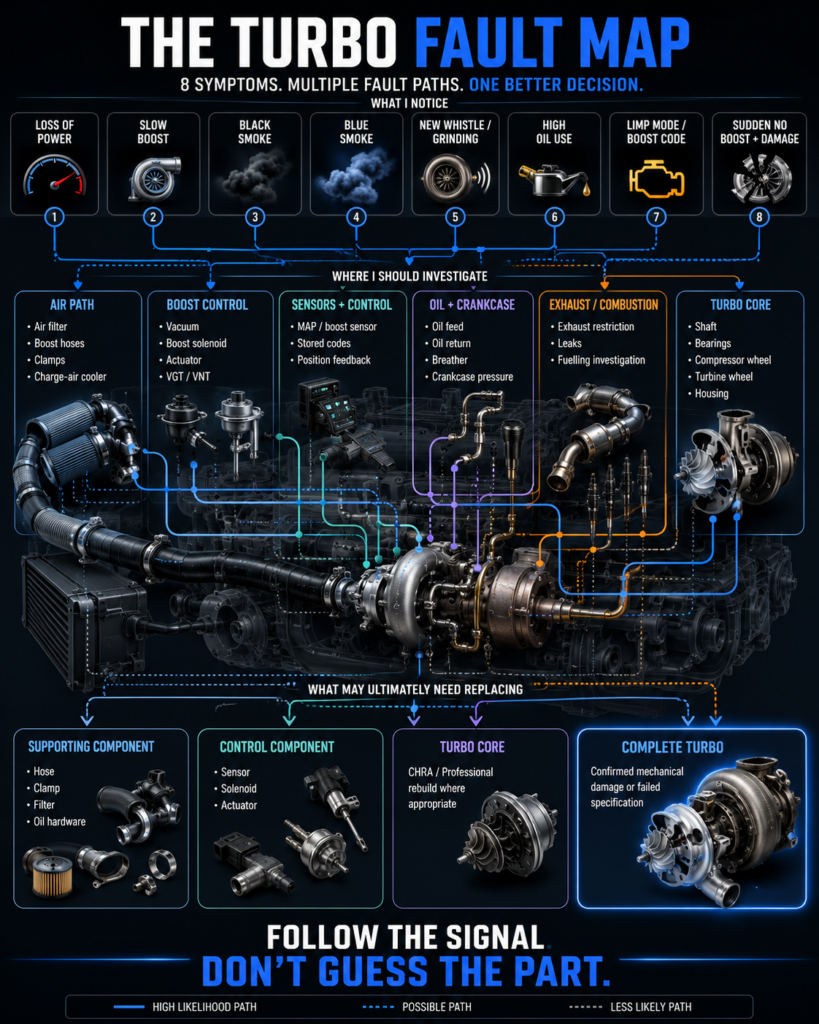
Diesel Turbo Symptom-to-Replacement Guide
| What you notice | What should be checked first | What may need replacing |
| Loss of power | Boost hoses, intake filter, charge-air cooler, actuator | Hose, filter, cooler, actuator or turbo |
| Slow or delayed boost | Charge-air leaks, vacuum supply, VGT/VNT control, sensors | Hose, solenoid, sensor, actuator or turbo |
| Black smoke | Airflow, boost pressure, fuelling, exhaust restriction | Filter, hose, sensor, control component or turbo |
| Blue smoke | Oil feed/return, breather, crankcase pressure, turbo condition | Oil line, breather component, CHRA or turbo |
| New whistle or grinding | Boost/exhaust joints, shaft and wheels | Hose, gasket, core or turbocharger |
| High oil use | Oil drain, crankcase pressure, internal turbo condition | Oil hardware, breather, CHRA or turbo |
| Surging or limp mode | Fault codes, actuator, vane position, sensors | Actuator, solenoid, sensor, vane system or turbo |
| Sudden no boost with mechanical damage | Lubrication system, wheels, shaft and housing | CHRA, complete turbo and related damaged parts |
What Most People Get Wrong: Replacing the Turbo Before Finding the Cause
The costly mistake is treating the turbocharger as an isolated component.
Fresh April 2026 guidance from Melett, reported by the Independent Automotive Aftermarket Federation, says insufficient lubrication remains one of the common underlying causes of turbocharger failure and is frequently connected to oil-supply problems elsewhere in the engine.
Melett Group Product Manager Tom Wright puts the risk clearly:
“Even a few seconds of turbo operation without oil can be enough to cause irreversible damage to the bearing system.”
Melett’s own technical guidance on insufficient lubrication also identifies restricted oil-feed pipes, carbon deposits, poor filter maintenance, low oil level and failure to prime a replacement turbo as potential causes.
The practical rule is simple:
Do this: confirm the failure path, correct the cause, then source the replacement.
Not this: see low boost, order a turbo, then leave the split hose, restricted oil feed, blocked breather or failed actuator untouched.
Replacing the expensive component does not fix the system that damaged it.
What Should You Confirm Before Ordering a Turbo or Related Component?
1. Record the Engine and Equipment Identity
Capture the engine make, model and serial number where available.
For a ute, heavy vehicle, generator, drill rig, excavator or other equipment, record the machine or vehicle model and relevant build details as well.
Correct identification matters because visually similar turbochargers can use different internal specifications, actuator settings or applications.
2. Find the Turbocharger Identification
Photograph the turbo nameplate or identification tag before the component is removed or cleaned.
Record:
- turbo manufacturer
- turbo part number
- OEM part number
- serial number where shown
- casting or stamped numbers that may help identification
If the original component proves difficult to source, Volfaryn Components Australia’s global procurement service can work from OEM numbers, part numbers and other application information.
3. Keep the Diagnostic Evidence
Retain stored fault codes and notes about when the failure appears.
Useful questions include:
- Does it happen only under load?
- Does normal power return after restarting?
- Is the smoke black or blue?
- Does the noise change with boost?
- Has oil consumption increased?
- Did the problem appear suddenly or progressively?
Those details can help separate an air-path fault from a control, oil or rotating-assembly problem.
4. Check Components That Can Mimic Turbo Failure
Before the RFQ is raised, confirm that the relevant supporting components have been considered:
- air filter
- intake hoses
- boost hoses and clamps
- charge-air cooler/intercooler
- actuator
- vacuum supply
- boost-control solenoid
- MAP/MAF or boost sensors
- oil feed and return
- crankcase ventilation
- exhaust leaks
- DPF or other exhaust restriction where applicable
The goal is not to replace all of them.
The goal is to stop the wrong component from being ordered because several faults produced the same symptom.
5. Decide Whether the Job Needs One Component or Related Parts
Confirmed turbo damage may affect more than the turbo itself.
Oil-starvation failures can involve feed hardware. Foreign-object damage can leave debris elsewhere in the intake path. Significant oil leakage can contaminate charge-air pipework or the intercooler.
The replacement list should follow the cause of failure, not simply the name of the largest damaged component.
OEM, Premium Aftermarket or Rebuild: Which Path Makes Sense?
The right path depends on the application, physical damage, availability and specification required.
OEM replacement may suit warranty-sensitive or tightly specified applications.
Premium aftermarket can be a practical option where a correctly matched component is available from a proven manufacturer.
Professional rebuilding may make sense when housings and major hard parts remain serviceable and the unit can be rebuilt, balanced and calibrated correctly.
Fitment matters more than appearance.
Actuator calibration, compressor and turbine specification, flange configuration and engine application can differ even when two turbochargers look nearly identical.
For obsolete, superseded or difficult applications, Volfaryn’s OE and premium aftermarket engine-component capabilities and hard-to-find parts sourcing give workshops and procurement teams another route once the failed component has been identified.
Why the Right Diagnosis Matters in Australian Heavy-Duty Work
Remote work makes a wrong parts decision more expensive.
The Australian Equipment Loss & Downtime Index 2026, published in July 2026, reports estimated unplanned downtime of $5,000 to $10,000 per hour for a large mining haul truck.
Actual downtime cost varies by site, machine and production plan, but the operational lesson is straightforward.
Part accuracy matters.
So does the time spent waiting for another freight movement because the first component did not match.
That same pressure affects mining, commercial transport, industrial equipment and other critical applications across regional WA and Australia.
When Should the Complete Turbocharger Be Replaced?
Turbo replacement becomes far more likely once diagnosis moves beyond driveability symptoms and finds physical damage.
Strong replacement indicators include:
- damaged compressor blades
- damaged turbine blades
- wheel-to-housing contact
- rotor seizure or tight rotation
- confirmed bearing damage
- clearances outside manufacturer specification
- cracked or badly damaged housing
- severe foreign-object damage
- internal variable-vane damage that cannot be repaired economically
BorgWarner notes that turbocharger components operate at very close tolerances and recommends checking the engine system before assuming the turbo itself is responsible.
That distinction is especially important when sourcing an expensive or difficult-to-find unit.
Need the Correct Component Once the Fault Is Confirmed?
Volfaryn Components Australia supplies and sources OEM and premium aftermarket engine components for automotive, commercial transport, industrial, mining and marine applications across Australia.
Already know the turbocharger, actuator or related component you need?
Send the OEM number, turbo part number, engine and equipment details, quantity and delivery location through the Volfaryn procurement request.

Still dealing with an obsolete, discontinued or hard-to-source number?
Use Volfaryn’s Request a Part Search process so sourcing starts from the exact application rather than a similar-looking substitute. You can also review the current engine component catalogue before submitting the enquiry.
Final Thoughts: Diagnose First, Then Replace the Right Part
The best use of diesel turbo failure symptoms is not to prove that the turbo is bad.
It is to narrow the fault quickly enough to make the next decision better.
Loss of power may lead to a boost hose. Surging may lead to an actuator. Blue smoke may lead to the oil circuit or turbo core. Grinding combined with wheel contact points much more strongly towards the turbocharger itself.
Confirm the cause. Record the exact identifiers. Then source what the engine actually needs.
That approach reduces guesswork, lowers the risk of repeat failure and gives workshops, maintenance teams and procurement buyers a much cleaner path from symptom to replacement.