
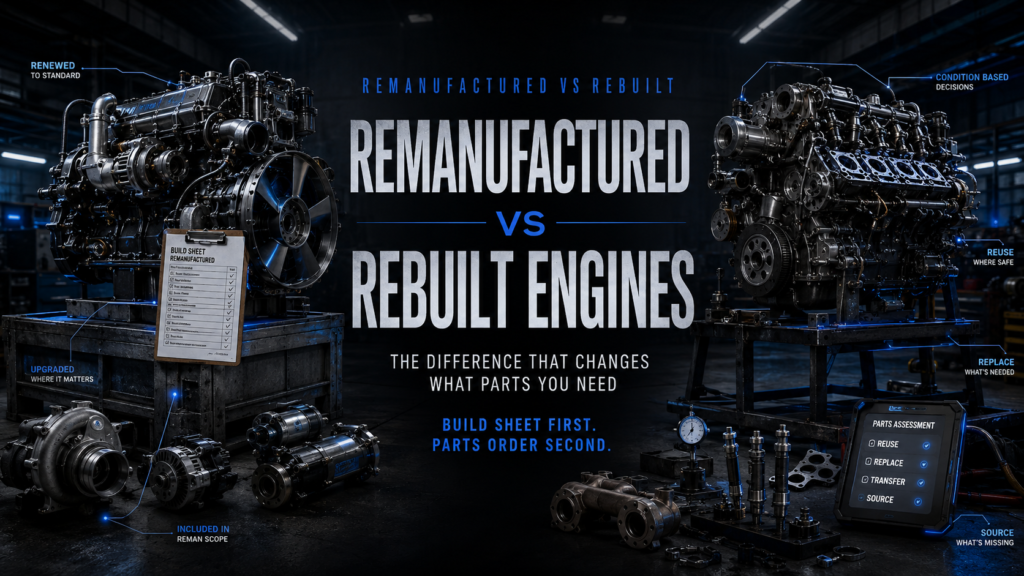
The label on an engine quote can change your whole parts order.
Comparing a remanufactured vs rebuilt engine is not only about the label. Remanufacturing usually follows a broader documented specification, while rebuilding is more likely to follow what the workshop finds during teardown. That changes what gets renewed, what can stay and what still needs to be sourced.
For a workshop or engine rebuilder, that is the useful question: what parts are actually included, and what will you still need before the engine can go back into service?
Key Takeaways
- Remanufactured and rebuilt do not guarantee the same replacement-parts list.
- The build sheet matters more than the label because it shows what is new, restored, reused and excluded.
- Short block, long block and complete-engine packages can create very different additional parts requirements.
- Confirm engine identification and package contents before ordering rebuild components.
What is the difference between a remanufactured and rebuilt engine?
Remanufacturing generally means complete disassembly, cleaning, inspection and restoration against a defined specification, with components renewed, machined or replaced according to that programme. Rebuilding usually follows the condition of the individual engine, so serviceable parts may remain while worn, damaged or out-of-tolerance components are repaired or replaced.
Terminology varies between suppliers. Independent rebuilders can carry out extensive machining and parts renewal, while OEM remanufacturing programmes may publish mandatory replacement requirements.
Ford Australia’s engine remanufacturing guidance shows how specific an OEM programme can be. Ford says its remanufactured engines return to original factory specification and lists pistons and rings, big and small-end bearings, all gaskets and oil seals, timing chains or belts, rocker and valve assemblies, and yielded fasteners among mandatory replacement items.
That list applies to Ford’s programme. It should not be copied across every engine or supplier.
The practical rule is simpler: compare the documented build, not the name on the quote.
Why does the difference change your parts list?
Scope changes procurement.
During a rebuild, hard parts such as the block, crankshaft, rods or cylinder head may be measured, machined and reused when suitable. The workshop then orders parts around the wear and damage found.
Structured remanufacturing usually works from defined acceptance and renewal rules. Suitable core parts can still be restored and reused, while wear items follow the remanufacturer’s specification.
That creates two common differences for a workshop:
- More internal parts may already be included in a remanufactured assembly.
- External components may still be excluded, even when the engine is sold as remanufactured.
The second point causes many avoidable ordering problems.
Remanufactured vs rebuilt engine parts: what should you compare?
| Parts area | Remanufactured engine | Rebuilt engine | What to verify |
| Block, crankshaft, rods, cylinder head | May be inspected, restored and reused if they meet the programme specification | May be reused if the rebuilder finds them serviceable | What was measured or machined? |
| Pistons, rings and bearings | Often covered by a defined renewal standard | Replaced according to condition and scope | Which items are new? |
| Gaskets and oil seals | Commonly renewed | Commonly replaced during reassembly | Is the complete sealing set included? |
| Timing and valvetrain | May have mandatory replacement rules | Depends on wear and rebuild scope | Which chains, belts, guides, valves or rockers are included? |
| Oil-system parts | Varies by reman programme | Inspected or replaced as required | Is the oil pump or cooler included? |
| Injectors and fuel system | Depends on engine package | Often separate unless quoted | What transfers from the old engine? |
| Turbocharger | May be included in a full reman engine but excluded from a long block | Often separate unless included in the job | Is the turbo being reused or replaced? |
| Starter, alternator, sensors, wiring | Frequently outside long-block supply | Usually reused unless quoted | What must be transferred? |
Price only becomes meaningful after those contents line up.
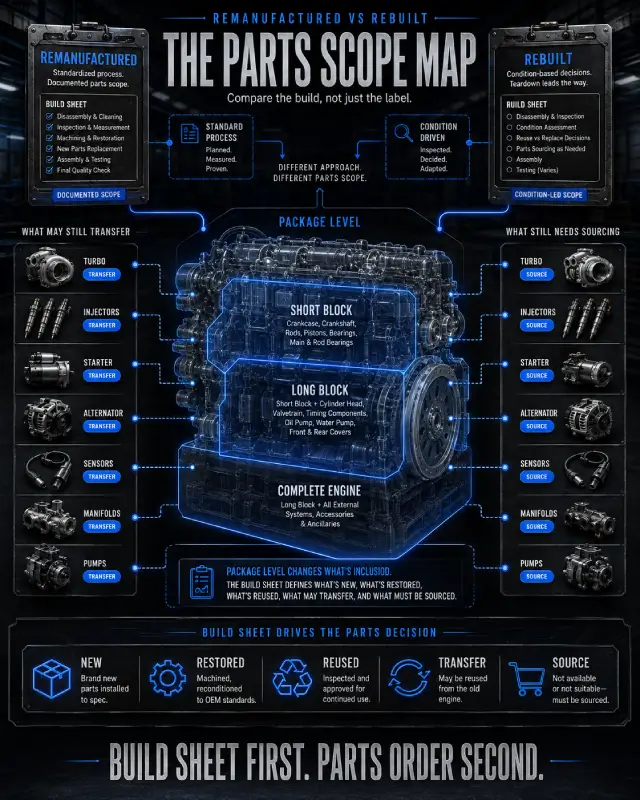
Short block, long block or complete engine: why the package matters
Package type can change the parts order just as much as the rebuilt-versus-remanufactured decision.
Short block
Short blocks generally cover the block, crankshaft, connecting rods, pistons and related lower-end components. Cylinder heads and many upper-engine parts usually sit outside the package.
Long block
Long blocks normally add the cylinder head or heads and much of the valvetrain. They reduce the precision assembly left for the installer, but the turbocharger, fuel system, starter, alternator, manifolds, sensors and application-specific hardware may still be separate.
Cummins provides a strong current example. Its 2026 ISX/X15 ReCon specification lists the full ReCon engine with the turbocharger, fuel pump, fuel lines, exhaust manifold, injectors and wiring loom among its components. The same document says the ReCon long block allows reuse of external components including the turbo, air compressor, starter, alternator, fuel pump and fuel lines.
Same remanufacturing family, different package, different parts requirement.
Complete or dressed engine
More complete assemblies can add systems a long block leaves out, but definitions differ. Get the inclusion list before treating a “complete engine” quote as installation-ready.
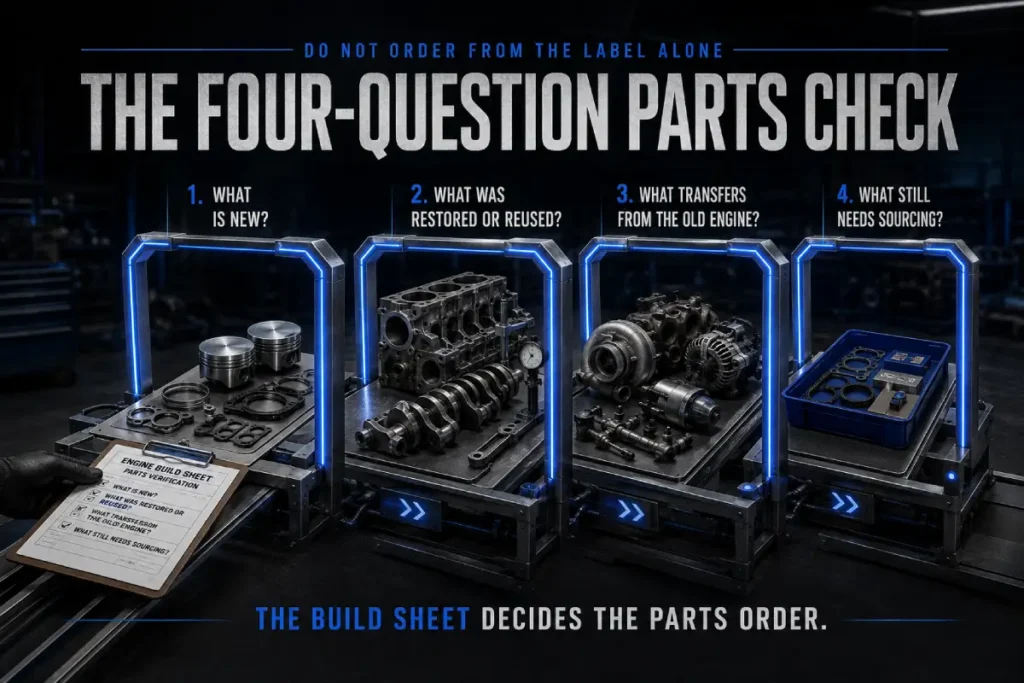
Use this four-question parts check before ordering
Forget the label for a moment. Ask four questions.
1. What is new?
List every component supplied new in the build. Depending on the programme, this may include pistons, rings, bearings, seals, timing parts or valvetrain items.
2. What was restored and reused?
Identify core components that were measured, machined or reclaimed for service. Ask what specification or acceptance criteria they had to meet.
3. What must transfer from the old engine?
List the turbocharger, injectors, manifolds, pumps, starter, alternator, sensors, wiring and brackets not included in the replacement assembly. The original failure still matters before any part transfers.
4. What still needs to be sourced?
Anything missing from the engine package and unsuitable for transfer becomes a procurement item.
That final list is where Volfaryn Components Australia’s engine-component procurement service is most relevant, particularly when the required part is obsolete, superseded or difficult to find through normal local supply.
What should you check before reusing external components?
Failure history matters.
Oil starvation, overheating, contamination or foreign debris can affect parts outside the core engine. Reusing them without considering the failure path can carry the original problem into the replacement assembly.
Consider the turbocharger on an oil-starved diesel. Its condition deserves more scrutiny than a turbo removed from an engine that failed for an unrelated reason. The same logic applies to injectors, oil coolers, cooling components, pumps and other transferred parts.
Volfaryn is a component supplier and sourcing partner, not a repair workshop. The sensible endpoint is therefore: the rebuilder confirms what can stay, then the required replacements are matched to the correct engine application and part number.
What most buyers get wrong
Mistake 1: Treating remanufactured as another word for new
Remanufacturing normally retains suitable core components after inspection or restoration.
Do this: ask which parts are new, restored and reused.
Not that: assume every internal component has been replaced.
Mistake 2: Assuming rebuilt automatically means basic work
High-quality rebuilds can involve extensive inspection, machining and component renewal. Judge the actual process, not the label alone.
Mistake 3: Comparing prices before comparing contents
Cheaper long blocks can require a turbo, injectors, pumps and other ancillaries that a more complete quote already includes.
Mistake 4: Ordering parts before the build scope is final
Teardown findings and the final build sheet should define the parts order. Ordering too early can create duplicates while still missing the component that holds up the job.
A practical workshop example
Picture a heavy-duty diesel with significant bottom-end damage after a lubrication problem.
The rebuilt route keeps suitable hard parts, machines the crankshaft if it passes inspection, then replaces the bearings, rings, gaskets and other parts identified by the rebuild scope.
The remanufactured long block arrives with a broader set of internal parts already assembled.
Then the package list shows that the turbocharger, starter and alternator are not included. The turbo has also been exposed to the same lubrication problem that damaged the engine.
The real comparison is no longer “rebuilt or remanufactured?” It becomes:
- What is already covered inside each engine?
- What can genuinely be reused?
- Which external components need inspection?
- What must be sourced before installation finishes?
That is the comparison a workshop can act on.
Does remanufacturing have a measurable benefit beyond parts supply?
Yes, but the numbers need proper context.
On 27 August 2026, MAN Truck & Bus published a lifecycle assessment of its D2842 LE622 rail engine. The study, conducted by the University of Bayreuth and independently validated on behalf of DEKRA Assurance Services, found that the MAN Genuine Remanufactured Engine produced 72% less greenhouse-gas emissions within the study boundaries than the newly manufactured reference engine. MAN also reported 80% lower use of new materials.
Those figures apply to that specific engine and assessment, not every remanufactured engine.
Josef Lukaschtik, Head of Remanufacturing at MAN Truck & Bus, said:
“The results show the enormous potential of extending product life cycles.”
The finding shows how remanufacturing can retain serviceable components instead of replacing the whole engine with newly manufactured material.
Five steps before an Australian workshop raises the parts order
Step 1: Confirm the engine identity
Record the engine manufacturer, model, engine code and serial number. Add the vehicle, machine or equipment model where relevant.
Step 2: Get the build sheet
Request the inclusion list, renewal list and assembly level. Terms such as “long block” or “fully rebuilt” are not detailed enough for procurement.
Step 3: Mark every transferred component
List the turbocharger, injectors, pumps, manifolds, sensors, starter, alternator and cooling components expected to move from the original engine.
Step 4: Identify the actual sourcing gaps
Separate missing parts from components that are present but not suitable for reuse. Record OEM numbers, manufacturer numbers, casting numbers or stamped markings where available.
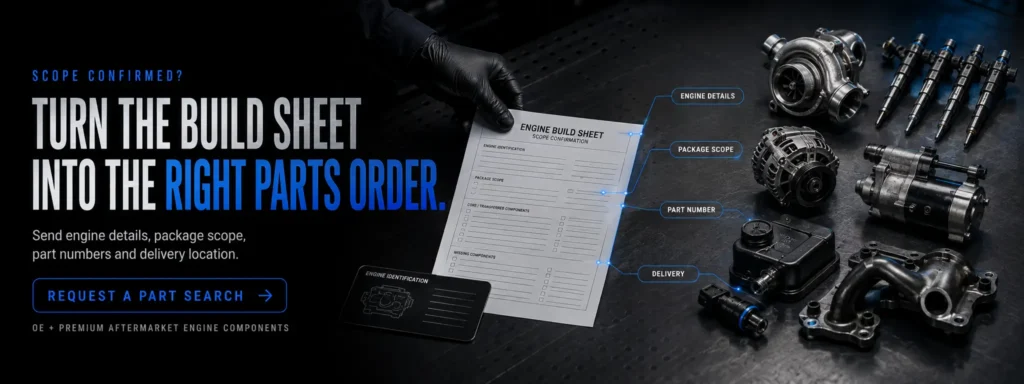
Step 5: Raise one clean procurement request
Send the engine details, required components, quantities and delivery location together. For regional WA workshops, mine sites and other remote operations, getting the list right before freight moves can prevent another avoidable supply cycle.
OEM or premium aftermarket: what happens once the scope is clear?
Once the component list is final, the workshop can decide where genuine OEM parts are required and where a correctly matched premium aftermarket option fits the build specification.
That decision depends on the engine, application, rebuild specification, warranty and availability. Older heavy vehicles, industrial engines and mining equipment can remain in service after original parts become difficult to obtain, so superseded numbers matter.
Volfaryn Components Australia supplies OEM and premium aftermarket engine components for workshops, engine rebuilders and Australian businesses across automotive, commercial transport, mining, industrial and marine applications. Its engine components catalogue is a starting point, while its broader sourcing capability covers parts outside the listed range.
The company’s industry supply capability also covers workshops, engine rebuilders, heavy vehicles, mining fleets and industrial equipment where the correct application, OEM number and component specification matter more than a visually similar substitute.
Final Thoughts: build the parts list around the actual engine scope
The useful difference between remanufactured and rebuilt engines is not the wording on the quote. It is the scope behind it.
Remanufacturing may give the workshop a more standardised internal parts package. Rebuilding may give the rebuilder more freedom to retain serviceable components. Either route can make sense when the process, parts and application are clear.
Costly mistakes often happen outside that distinction: assuming a long block includes the turbo, ordering parts already supplied, or transferring a damaged ancillary.
When comparing a remanufactured vs rebuilt engine, get the build sheet first. Work out what is new, what stays, what transfers and what is still missing.
If the remaining component is obsolete, superseded or difficult to source, send Volfaryn Components Australia the engine details, OEM or part number, quantity and delivery location through the Request Part Search.